
In all the galaxies of all the universes (if you subscribe to M-theory, AKA String theory), we found ourselves here as the apex predator on Earth’s planet. Well, it really does boggle the mind that things could have ventured differently by only minor evolutionary derailments and misadventures in Earth’s History to be something completely different, or not at all. Regardless, here we are- Homo sapiens sapiens: the modern humans, the wise ones. Talk about living up to the hype! The bigger questions on your mind might be more like, “Why the hell a second ‘sapiens’? Was there another sapiens that we missed?”
To better understand why there is a reiteration of the word sapiens, we must first understand that back in the day (which was, of course, a Wednesday and the 18th century), a Swedish naturalist by the name of Carl Linnaeus thought it was high-time to label our flora and fauna better. And for shits and giggles, he put it in good ol’ Latin. Now, Carl Linnaeus gave us genus and species, the last two ranks of hierarchies in taxonomy.* In his work Systema Naturae, he went on to take it one step further in his classification of Humans (Homo). Linnaeus saw fit to differentiate by skin color, customs, and geography; calling them varieties, in what can be seen as an attempt to subdivide humans further racially; americanus, europaeus, asiaticus, and africanus. While Systema Naturae made its way through 10 different editions, each subsequent printing added new information to the four varieties that affected their placement in their hierarchy. Not surprisingly, due to historical evidence and the apparent ethnocentrism of the time, africanus remained at the bottom of the classification. I’m sure the Nazis, loved this and thought it was a point on their side on how blonde hair, blue-eyed people were destined to be the superior race (I am very loudly rolling my eyes). The early years of science and anthropology were not the greatest in mankind, and it really makes you wonder what they were drinking when labeling us the “wise” ones.
Now, it was later established that there was even more diversity within species than previously imagined. This now leads us to the much-awaited drum roll… subspecies! This new classification has been widely recognized among scientists and can officially be added to the canonical order of taxonomic classification. Just another fun bit- not all species will have subspecies.
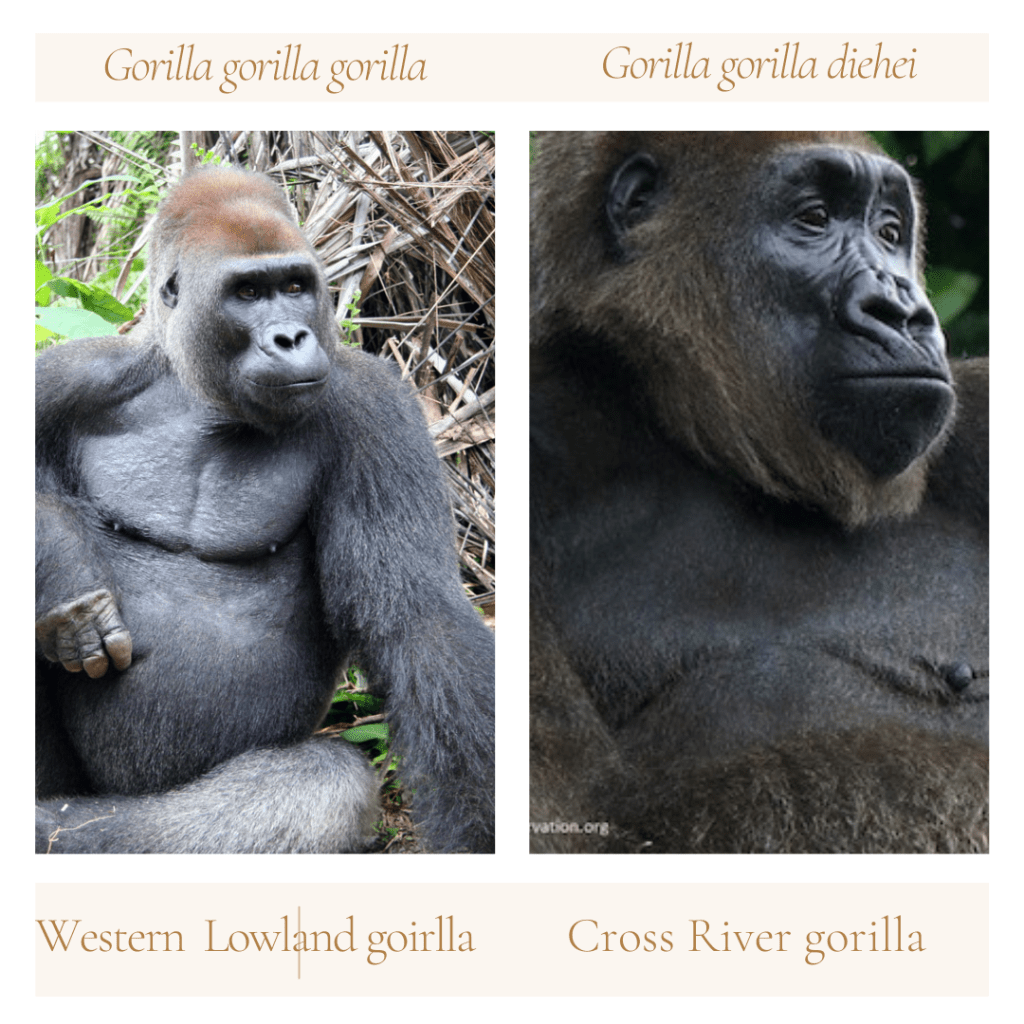
An example of how subspecies is correctly utilized is by looking at the two subspecies within the abundant Gorilla gorilla species (western gorillas)—the Western lowland gorilla, Gorilla gorilla gorilla, and the Cross River gorilla, Gorilla gorilla diehei. They both live in the same subtropical region in Africa, but their nose and the sounds they make when communicating differ. By just looking at the two below, it can be said that those two are in fact, very similar, like cousins, if you will.
Now, back to us, the “wise” ones. Our journey to scientifically be known as Homo sapiens sapiens had a clear rough start, but we can denote that our homonid evolution in the closest sense begins with our archaic brethren. The journey to Homo sapiens sapiens is not as clear-cut and agreed upon in the science community as we’d like it to be. Just like we are still trying to find the connecting link between single-cell organisms and the rise of multicellular organisms, this has been just as taxing. Comparative anatomy and genomics have been vital to helping build our phylogenetic tree. For the sake of simplicity, the subspecies encompassing archaic humans are just what you might think; they are pretty close to us but have some defining morphological and genetic variations. One difference that is consistently brought up is that of cranial capacity. We modern humans average a cranial capacity of 1350cc, while our earlier counterparts were on the smaller end. An exception to this is the Neanderthals, whose cranial capacity is averaged at 1400cc. Bigger isn’t always better; they clearly didn’t have what it takes to reign supreme. And that is where things get messy. With the constant advances in science and limited skeletal remains, placing newly found species/subspecies in an all-around agreed place has been contested. Not all, but more than we’d like.
Wherever they may find their final place in our taxonomic order, one characteristic of a subspecies is that they have the potential to interbreed with one another. So that Neanderthal or Denisovan DNA doesn’t seem so far fetch now.
I leave you with some early human information put more comically and conversationally. Imagine us drinking a glass of Rose and talking about the days when fire was the definition of the one percent… or the ones destined to continue evolving.
Homo ergaster
AKA: Homo Erectus
Fun fact: Not only did this guy find his way out of Africa, but he also felt like hot food was more delicious (first to use fire…just making sure you got that).
Homo habilis
AKA: Australopithecus habilis, handy man
Fun fact: Even with a cranial capacity of 510cc, he could still fashion tools out of stone. Clearly no excuse as to why men can’t at least remember to put the toilet seat down.
Homo neanderthalensis
AKA: Neanderthals
Fun fact: According to genetic traces on Neanderthal DNA, it would appear that the first dalliance between Homo sapiens and Neanderthals occurred with a male Neanderthal and a female H. sapiens
Homo heidelbergensis
Fun Fact: New evidence may suggest that Homo sapiens and Homo neanderthalensis evolved from Homo heidelbergensis.
Notes
*The standard ranking goes something like this: Kingdome, Phylum, Class, Order, Family, Genus, Species. An excellent way to remember it is by using a mnemonic. I tend to sway toward the amusing ones, such as, “King Phillip came over for group sex.”
Sources
National Academies of Sciences, Engineering, and Medicine; Division on Earth and Life Studies; Board on Agriculture and Natural Resources; Board on Life Sciences; Committee on Assessing the Taxonomic Status of the Red Wolf and the Mexican Gray Wolf. Evaluating the Taxonomic Status of the Mexican Gray Wolf and the Red Wolf. Washington (DC): National Academies Press (US); 2019 Mar 28. 2, Guiding Principles for Identifying Species and Subspecies. Available from: https://www.ncbi.nlm.nih.gov/books/NBK542546/
“Types of Gorillas.” 2023. Adelphi.edu. 2023. https://home.adelphi.edu/~al21824/Types%20of%20Gorillas.html#:~:text=The%20western%20gorilla%20species%20consists,their%20sound%20when%20they%20communicate..
Chu, Angus C. 2023. “Human Brain Evolution in a Malthusian Economy Munich Personal RePEc Archive.” Uni-Muenchen.de, April. https://mpra.ub.uni-muenchen.de/117130/1/brain%20size%20evolution.pdf.
Wielgus, Karolina, Mikołaj Danielewski, and Jarosław Walkowiak. 2022. “Svante Pääbo, Reader of the Neanderthal Genome” 237 (1). https://doi.org/10.1111/apha.13902.
Rutherford, Adam and Siddhartha, Mukherjee. 2017. A Brief History of Everyone Who Ever Lived: The Human Story Retold Through Our Genes. New York, NY, The Experiment, LLC.
Reich, David. 2018. Who We Are and How We Got Here: Ancient DNA and the New Science of the Human Past. New York, NY, Penguin Random House, LLC.
Harari, Yuval Noah. 2015. Sapiens: A Brief History of Humankind. New York, NY, HarperCollins.
Freeman, Scott, and Herron ,Jon. 2004. Evolutionary Analysis, Third Edition. Upper Saddle River, NJ, Pearson Prentice Hall.
 The Homo Sapien Sapien