Part two, baby!
This is where the magic happens, figuratively, of course. This is science, not magic. Knowing the number of protons in an atom will allow you to identify the element, but it is the glorious electron that allows for bonds and all physical phenomena to occur. I’m talking about electricity, magnetism, chemistry, and thermal conductivity. As far as we know, the electron is an elementary particle and, like protons, is classified as a lepton. Leptons are part of fermions, which, once again, are what make up the matter in the universe.
Electrons are not just particles, but they also show properties of a wave, known as the wave-particle duality. Electrons don’t orbit around the nucleus like planets do with the sun. Rather, they are in a constant state of excitation moving and jumping orbitals. Heisenberg’s Uncertainty Principle explains how we can either know the location of an electron or it’s velocity, but not both. They’re like that one friend who will only tell you where they’re going or came from, but not both. It was this principle that then led Paul Dirac (a true badass in physics) and Erwin Schrödinger to develop the field of quantum mechanics. Because clearly, these subatomic particles did not adhere to Newtonian physics (or classical mechanics, whatever suits your fancy).
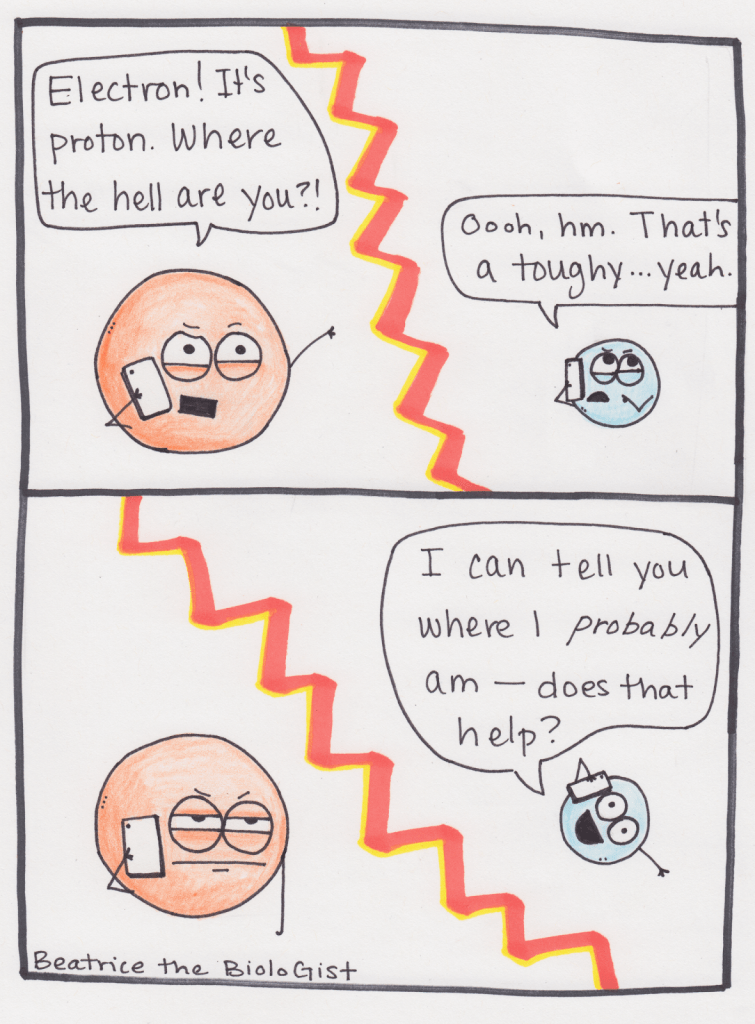
Electrons don’t really follow the laws of physics that we experience in our everyday existence. They break all the “rules” as we know them. They can be in two states at once, they can move through energy barriers (which would be like us moving through a hill rather than walking over it), and they change their behavior when we try to measure them. They just don’t make any sense! Gah!
-Beatrice the Biologist
So how are they the hardest working lepton? Well, let’s start with the electrons found in the outermost shell of an atom, the valence electrons.
Valence electrons are the key to the magic of the phenomena mentioned earlier. Looking at man’s greatest creation, The Periodic Table of Elements, you will see that it is arranged not only by atomic number, but grouped by families that share similar properties thanks to the electrons! The number of valence electrons will dictate how elements will react with other elements. The ability for electrons to flow from one atom to another is electricity. The more availability there is in the outer orbitals the more freely these electrons will move about.
What are the top three conductors of electricity?
- Silver (Ag): [Kr] 4d10, 5s1
- Copper (Cu): [Ar] 3d1, 4s1
- Gold (Au): [Xe] 4f14, 5d10, 6s1
Go ahead, take a look at where they fall in the periodic table and the properties they hold.

They are characterized as transition metals, meaning they are good conductors of heat and electricity, they’re malleable, and most transition metals have multiple oxidation numbers (the ability to lose or gain electrons when bonding with another element). All three of the top conductors of electricity have one valence electron (bust out your electron configuration skills! Remember to put it in its most stable state. Or just look at the list again).
The role of electrons in magnetism also involves the nucleus. Not only does an electron revolve around the nucleus, but it is also spinning itself, as is the nucleus. They each induce their own magnetic moments, and if taking the result of these magnetic moments induce a net magnetic moment that points in the same direction, then we know that the material will react like a magnet. However, if the net magnetic moment points in all kinds of directions, then they would cancel each other out, and the material would not act as a magnet. Need examples of why understanding magnetism is important? Well just look around: your computer uses magnets, television (so important!), transformers, generators, and a little machine like the MRI comes to mind. It literally has word magnetic in it (Magnetic Resonance Imaging).
If you’d like to see it explained in a video, this is the best.
Now in chemistry, valence electrons are also responsible creating and making bonds. One way to determine the kind of bond that will occur between two elements is by comparing their electronegativity. “Large differences in electronegativity result in ionic bonds, while smaller differences result in covalent bonds.” –Khanacademy.org
Ionic bonds transfer electrons to other atoms, whereas covalent bonds are incredibly nice, they share electrons. Remember, bonds are created when each element can fill their outer shell creating a happy and stable bond. Kind of like what we like to think marriage is.
Fun fact: Hydrogen has one electron. But since it only has one orbital and we know that that orbital can hold a maximum of 2 electrons. That means in order for this element to just be hydrogen, it is ALWAYS paired! It is a diatomic particle. So whenever you have a chemical equation to write out and they just say hydrogen, remember it’s going to be H2 (because there will be two of them, H-H), not H. H is unstable and cannot be on its own.
Lastly, I will leave you with this on the electron. As of July 7th 2023, Science reported that physicists have come to realize that the electron is actually incredibly spherical. Why is this important? Well, we are trying to understand why there is more matter than anti-matter in the universe. The way our universe is explained through mathematical theories is through symmetry. However, this cannot be the case. If we did in fact have symmetry in our universe, then we would have the same amount of matter and anti-matter in our universe during the Big Bang. This would have in turn had all protons and anti-protons, electrons and anti-electrons all collided with one another, and since there is symmetry, they would cancel each other out. The Universe we know would just be light. Clearly, this isn’t the case, and this query has led scientists to search for unknown particles that violate the charge-parity symmetry. If the electron had shown to have an electric dipole moment (eEDM) greater than zero, then it would show that it was more egg shaped. It’s really had to try and stand an egg up on its own. The shape is asymmetrical and could have signaled that there is another unknown particle that was in more abundance (matter wise). As it happens, we can now see that there really is no eEDM in the electron. It’s closeness to zero just let’s us know this isn’t the one we’re looking for. If you’d like to know more on this, let me know.
Sources
Hawking, Stephen, 1942-2018. A Brief History of Time. New York. Bantam Books. 1998.
Khan Academy. “Predicting Bond Type (Electronegativity),” 2023. https://www.khanacademy.org/science/ap-chemistry-beta/x2eef969c74e0d802:molecular-and-ionic-compound-structure-and-properties/x2eef969c74e0d802:types-of-chemical-bonds/v/predicting-bond-type-electronegativity#:~:text=One%20way%20to%20predict%20the,differences%20result%20in%20covalent%20bonds..
Marks, Magic. “How Do Magnets Work? | Engineering Physics.” YouTube Video. YouTube, January 16, 2014. https://www.youtube.com/watch?v=MRqQQGO7Xe8&feature=youtu.be.
 The Homo Sapien Sapien