Hydrogen, the first element on the most beautiful table of all, the periodic table of elements.
At the beginning of the Universe, also known as the Big Bang, the Universe comprised mostly two elements, one of which was hydrogen. Hydrogen is the most abundant element in the Universe. It makes up seventy-three percent of the visible mass in the Universe. Henry Cavendish recognized it as its own element in 1766, but it was not named until the one and only Antoine Lavoisier came along in 1783.
Fun side fact on Lavoisier: He is responsible for writing the first chemistry textbook. I want to show some respect to all the women in the lives of these early scientists that allowed these men to have the time to make significant contributions to science. God knows they didn’t have to worry about where their next meal was coming from or if they had clean clothes to wear the next day
Side thought

So here is a quick information on the lightest element on the Periodic Table
Symbol: H
Atomic number: 1
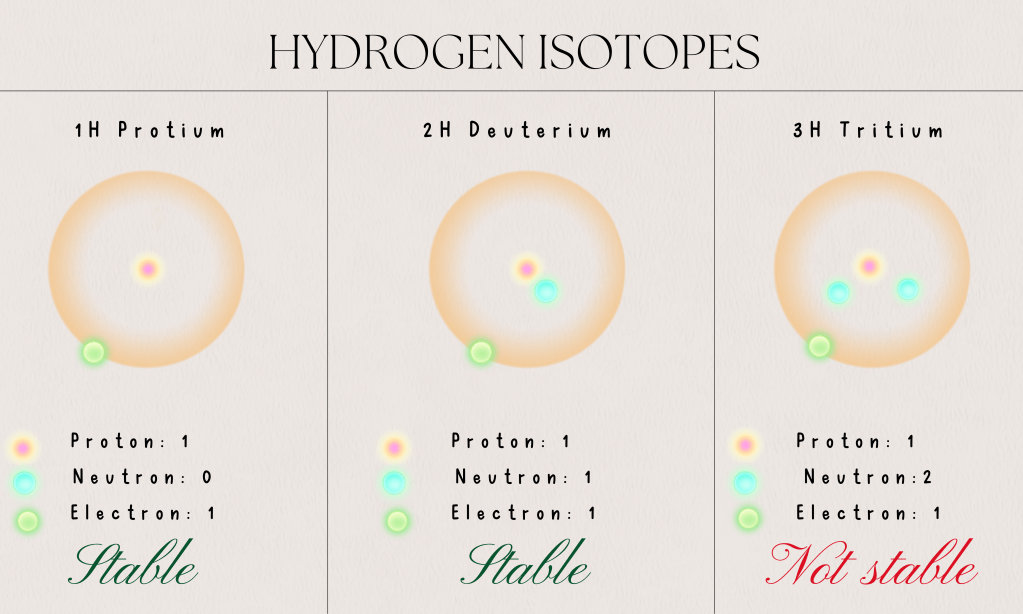
Number of Isotopes: 7 (two are naturally occurring and stable)
It is a diatomic molecule. This means hydrogen comes as a pair! Since it has only one electron and the orbital can hold two, for it to be stable, it finds another hydrogen atom to form a covalent bond (they share the electron).
The Universe
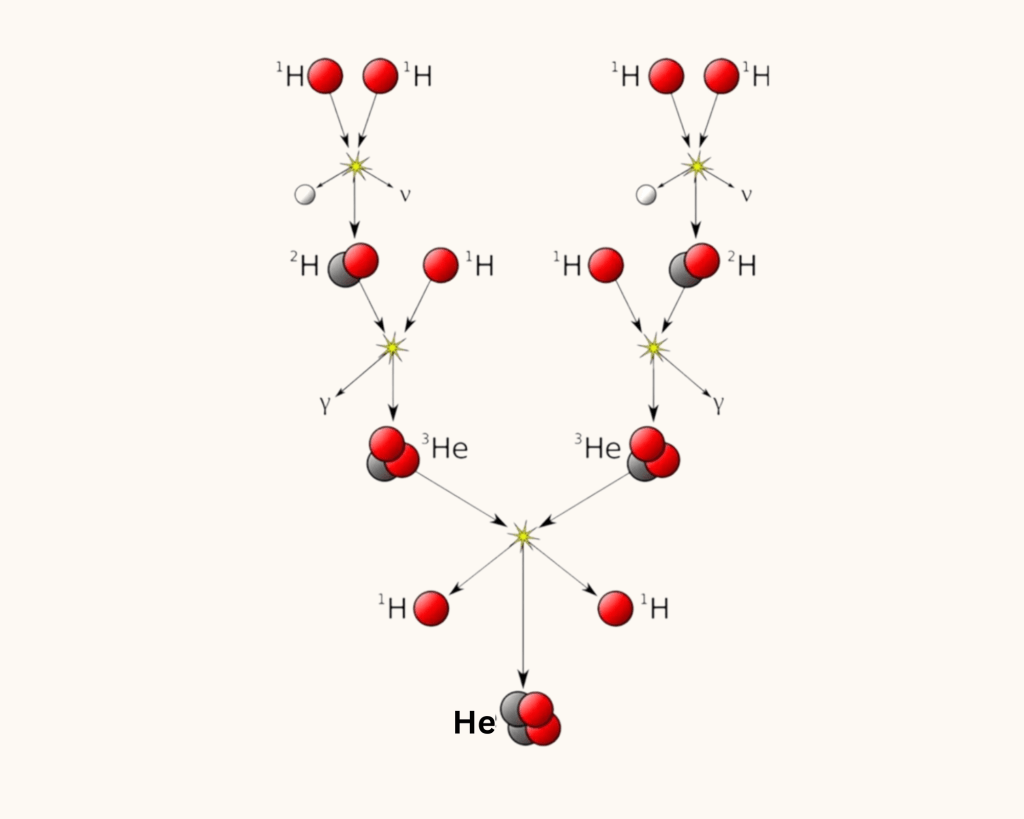
The Sun is a star, mainly composed of hydrogen in the plasma state. In this state of matter, the electrons are stripped away from the atom due to the immense heat and pressure. This heat causes the hydrogen atoms to fuse together and create helium. The coming together of these atoms is called fusion and releases gobs of energy. Every day the Sun converts 700 million tons of hydrogen into 695 million tons of helium.
Hydrogen Bomb
As you now know, the bombs dropped on both Hiroshima and Nagasaki were atom bombs, very different than hydrogen bombs. Atom bombs are based on the science of fission, the splitting of the atom that then creates a nuclear chain reaction. Hydrogen bombs are based on the release of energy when two atoms collide; this is called fusion. The release of energy is hundreds of times more powerful than that of fission. We know this because of Einstein’s equation of special relativity, E=mc2. One thing to remember is that to create this kind of weapon, you must first create so much heat that the atoms move so quickly that they overcome each other’s strong nuclear force (hotter than the core of the Sun). One reason hydrogen is the ideal element.
Although it is the lightest element in the periodic table, it is responsible for the life of most stars, our Universe, the Sun, and some of Earth’s deadliest weapons.
Sources
Kean, Sam, 2019. The Disappearing Spoon: And Other True Tales of Madness, Love, and the History of the World from the Periodic Table of Elements. Little, Brown and Company.
“Origin of the Elements.” 2023. Lbl.gov. 2023. https://www2.lbl.gov/abc/wallchart/chapters/10/0.html#:~:text=Approximately%2073%25%20of%20the%20mass,everything%20else%20represents%20only%202%25..
“The Universe’s First Type of Molecule Is Found at Last.” 2019. NASA. 2019. https://www.nasa.gov/feature/the-universe-s-first-type-of-molecule-is-found-at-last.
 The Homo Sapien Sapien